Ceuta migrant crisis exposes divisions within Europe, deepens tensions between Spain, the US: Chinese experts
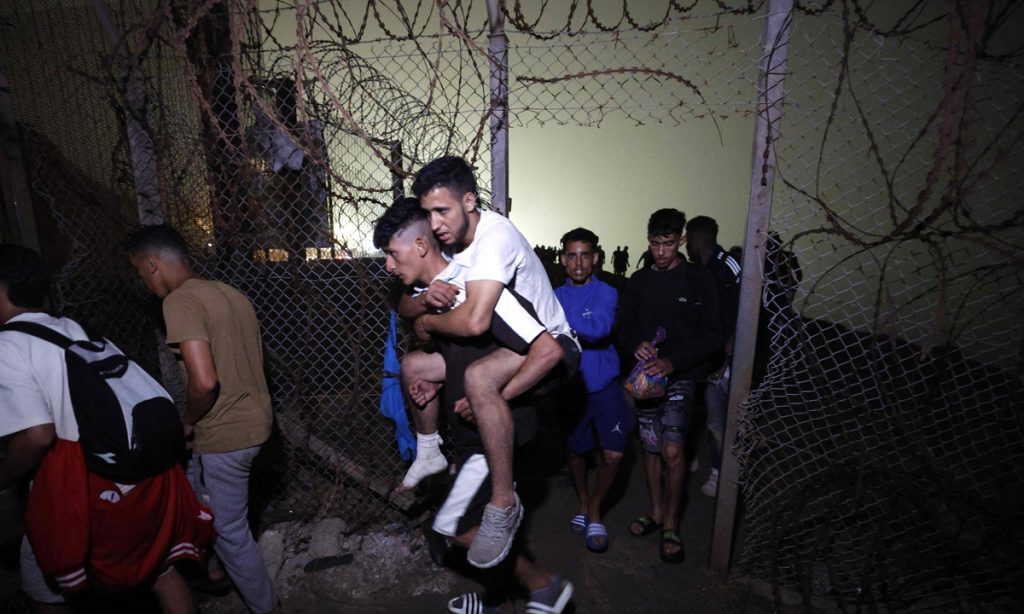
Driven by hunger, exhaustion and hostility, migrants who swam or climbed over fences to enter Spain's North African enclave of Ceuta were returning home on Saturday, Reuters reported. But the fallout from the crisis is expected to linger. Chinese experts said it has not only heightened tensions among European countries, but also provided fresh ammunition for Europe's rising right-wing parties, allowing them to further weaponize migration as a political issue.
"Selfish, polarizing and unlawful reaction" were the words Spain's Prime Minister Pedro Sánchez used in a letter to condemn EU countries, after Italy temporarily placed some border controls on travel from Spain, while France's Interior Minister Laurent Nunez ordered extra checks along the countries' shared border. Italian Prime Minister Giorgia Meloni also called for Spain's membership of the Schengen agreement to be suspended, CNN reported on Saturday.
Sánchez said in his letter that "such an attitude" was "driven by prejudice, fake news, ignorance or political interest." "In the current international context, the European Union cannot afford this kind of selfish, polarizing and unlawful reaction," he added, per CNN.
The surge of undocumented migrants crossing from Morocco into Ceuta triggered one of the most serious border crises Spain has faced in recent years, according to the Xinhua News Agency on Sunday.
The influx prompted Madrid to deploy military support, tighten border controls and strengthen coordination with Rabat. "Practically the entirety of those who entered Ceuta have already returned to Morocco," Spanish Foreign Minister Jose Manuel Albares wrote on X on Saturday. "It is not possible to travel from Ceuta and Melilla to the Peninsula without identifying oneself at a police checkpoint. The integrity of the Schengen Area is absolutely guaranteed."
Ceuta and Melilla, another Spanish territory 250 miles to the east along North Africa's Mediterranean coast, constitute the EU's only land borders with Africa, according to the Guardian.
"The latest figure that we have is 72," the Spanish government's delegate to Ceuta, Miguel Angel Perez Triano, told reporters, when asked about the number of fatalities, AFP reported. The previous toll was 67 deaths.
On Saturday, leaders from 22 European Union nations called for an emergency meeting to discuss the bloc's response to the Ceuta crisis. In the letter, which sources told Euronews was initiated by Italy and Denmark, member states called for "an extraordinary videoconference of the Ministers of the Interior," describing it as a "matter of urgency."
"We cannot allow uncontrolled mass crossings, the instrumentalization of migration or other hybrid threats to create the perception that illegal entry into the European Union is possible," the letter said, adding that they would consider "any necessary measures" to address such risks, "including through reinforcing or reintroducing temporary internal border controls."
Ireland, which currently holds the EU's rotating presidency, said a video meeting would take place on Tuesday, according to Euronews.
Tension inside and outside of Europe
The Ceuta crisis has prompted discussion about unity of the EU. Fox News reported that "the crisis is reverberating far beyond Spain because it challenges one of the European Union's central promises: that member states can maintain open internal borders while jointly protecting the bloc's external frontier."
"The international right has moved quickly too, highlighting the wider risk to European cohesion… The situation is a challenge to the free-movement settlement of a kind not seen since the 2015 crisis, whose reverberations included the UK's Brexit referendum the following year," according to an article published by Chatham House, a policy institute based in London.
The Ceuta crisis has laid bare the shortcomings of the EU's post-2015 migration reforms, underscoring the bloc's continued struggle to build a unified response to migration, Cui Hongjian, a professor at the Academy of Regional and Global Governance at Beijing Foreign Studies University, told the Global Times.
While the EU has spent years refining its migration rules, asylum system and burden-sharing mechanisms, those reforms have failed to address the bloc's deep-seated structural divisions, Cui said. The crisis demonstrates that when confronted with a sudden influx of migrants, longstanding disputes between frontline border states and inland member states over responsibility-sharing quickly resurfaced, with national interests once again outweighing collective European solidarity.
Moreover, the crisis has become a new point of contention among political forces across Europe.
In France, French far-right leader Marine Le Pen, who is running for president a fourth time, signaled she was planning to turn the Spanish crisis into a campaign theme.
"Faced with the massive and coordinated influx of migrants into Spain, encouraged by the Spanish government, France must without delay strengthen controls at its borders," she said on social media on July 31.
In Germany, the far-right party Alternative for Germany made major inroads in a federal election in 2017 by exploiting fears of uncontrolled immigration, and could win state elections for the first time this fall in eastern Germany, according to New York Times.
In Spain, Santiago Abascal, leader of the far-right Vox party, also accused Sánchez of inciting "an invasion" with his migration policies. "This national emergency can only be resolved by kicking him out" before Spain's next election next year, Abascal concluded, according to Politico.
Spain remains one of the few major EU member states still governed by a left-wing administration, making the Ceuta crisis a potent political weapon for right-wing parties seeking to challenge its migration policies, Jiang Feng, a researcher at Shanghai International Studies University and president of the Shanghai Regional Studies Association, told the Global Times.
With national and regional elections approaching in several European countries, where support for right-wing and far-right parties is rising, the crisis handed those parties a timely political issue. For them, migration has evolved beyond a humanitarian challenge into a powerful symbol of public insecurity, Jiang said.
Beyond Europe, officials in the US, which has been at odds with Spain over tariffs, also seized on the Ceuta crisis to criticize the Sánchez government and further politicize the immigration issue at home.
"I saw Spain yesterday, and I watched the catastrophe that took place," US President Donald Trump told a meeting of his cabinet at the presidential Camp David retreat in Maryland on Friday.
"It looks like an invasion of a country by hundreds of thousands of people, and that same thing's going to happen to us if the Republicans don't get elected, except worse, much bigger."
The Trump administration has long criticized what it describes as the permissive immigration policies adopted by some European countries, arguing that they have undermined social stability and weakened Western civilization. Against that backdrop, the Ceuta crisis has provided a timely example to reinforce that narrative, Cui said.
At the same time, Cui said, the political fallout from criticism of the Sánchez government by officials in the US could extend well beyond the migration crisis itself. If the issue continues to be exploited for political purposes, it risks further straining Madrid's relations with Washington and could lead to broader diplomatic tensions.