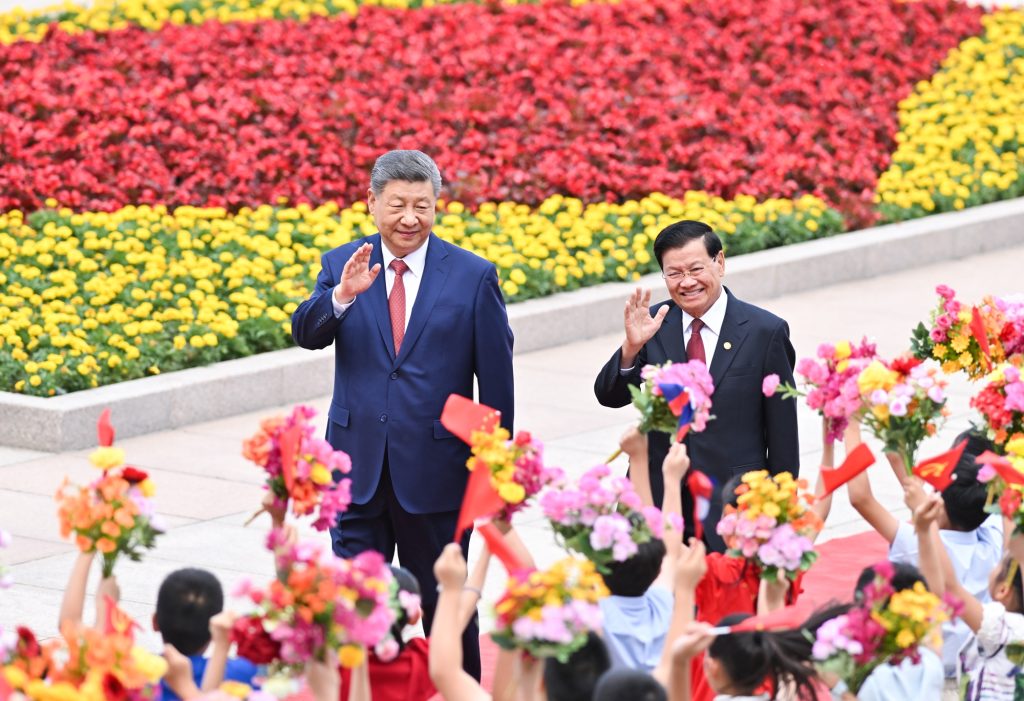
General Secretary of the Lao People's Revolutionary Party Central Committee and Lao President Thongloun Sisoulith lays a wreath at the Monument to the People's Heroes on Tian'anmen Square in Beijing, capital of China, June 5, 2026. (Xinhua/Dai Tianfang)
General Secretary of the Communist Party of China Central Committee and Chinese President Xi Jinping held talks with General Secretary of the Lao People's Revolutionary Party Central Committee and Lao President Thongloun Sisoulith in Beijing on Friday, the Xinhua News Agency reported.
According to Xinhua, Xi said China is willing to work with Laos to achieve a new leap in bilateral ties and build an all-weather China-Laos community with a shared future in the new era.
Laos fully agrees with China and supports the upgrading of bilateral ties, and stands ready to work with China to consolidate high-level political mutual trust, Thongloun said, per Xinhua.
After the talks concluded, the two sides jointly witnessed the signing of cooperation documents covering areas such as inter-party exchanges, people's wellbeing, finance, customs, trade, youth exchanges and media.
2026 marks the 65th anniversary of diplomatic relations between Laos and China and the China-Laos Friendship Year. Standing at a new historic juncture, experts note the two countries will not only expand pragmatic cooperation to nurture new growth drivers, but also ramp up regional coordination. Leveraging the exemplary role of their bilateral partnership in the neighborhood, China and Laos are poised to inject positive momentum into regional peace, stability and development.
Promising prospects
During the talks, the Chinese leader made four points to advance bilateral ties, which included keeping to the socialist path, building a strong foundation for mutually beneficial cooperation, strengthening the traditional friendship between the two peoples, and improving coordination on foreign policies, according to Xinhua.
He called on the two sides to take the establishment of the "3+3" strategic dialogue on diplomacy, defense and public security as an opportunity to deepen law enforcement and security cooperation, and resolutely crack down on cross-border crimes.
Noting that China is ready to work with Laos to upgrade the China-Laos Economic Corridor cooperation, Xi said the two sides should accelerate railway connectivity among China, Laos and Thailand and achieve greater regional connectivity at an early date, according to Xinhua.
China and Laos should boost cooperation in traditional areas such as agriculture and electricity, and tap into emerging fields like artificial intelligence and the digital economy, Xi said, adding that China will continue to provide assistance to Laos within its capacity.
Xi said that the two countries should take the Year of China-Laos Friendship in 2026 as an opportunity to expand cooperation in culture, education, health, and at subnational levels.
China now stands as the leading banner for the socialist system and developing countries, and a mainstay in safeguarding world peace and promoting the building of a multipolar world, said Thongloun, adding that China's development has provided valuable experience for the vast number of developing countries, including Laos.
He stressed that the Lao side firmly adheres to the one-China principle and supports the series of major global initiatives put forward by General Secretary Xi.
Xu Liping, director of the Center for Southeast Asian Studies at the Chinese Academy of Social Sciences, told the Global Times that guided by head-of-state diplomacy, political mutual trust between China and Laos has continued to deepen.
Drawing on the institutional strengths inherent to socialist systems, the two sides can further align their medium- and long-term development strategies to pursue common development, Xu added.
Ahead of his summit with Chinese leaders in Beijing, Thongloun kicked off his China itinerary with visits to Hangzhou in East China's Zhejiang Province. While touring the country's renowned tech hub, the Lao leader paid site visits to Deep Robotics as well as Alibaba. His cheerful laugh while testing out domestically developed Chinese quadruped robots has gone viral across Chinese social media platforms.
In Zhejiang, the Lao leader also learned about China's practices in green development at Yucun village in Anji county, the birthplace of the concept of "lucid waters and lush mountains are invaluable assets," which has guided the village to pursue an eco-friendly development path.
Upon his arrival in Beijing on Thursday, Thongloun visited the Party School of the CPC Central Committee, and returned to the room where he stayed for one month 26 years ago when he studied for an exchange program, as well as the China Academy of Space Technology.
Per Thongloun's visit itinerary and bilateral official statements, China-Laos cooperation is expanding beyond traditional sectors into emerging fields, said Xu. "Boasting strong complementarities in emerging growth drivers including green economy, digital economy as well as aerospace, the two nations enjoy enormous room for collaboration, promising deeper and more substantial pragmatic cooperation ahead."
According to China's Foreign Ministry, China-Laos economic and trade ties have continued to deepen in recent years, with China now serving as Laos' largest source of foreign investment and second-largest trading partner.
Bilateral trade reached $9.82 billion in 2025, up 19.3 percent year-on-year. China's exports to Laos totaled $4.32 billion, an increase of 17.6 percent, while imports from Laos rose 20.7 percent to $5.5 billion, according to the ministry.
Positive demonstration effect
During the Friday meeting with Thongloun, Xi said that China has always regarded Laos as a priority in its neighborhood diplomacy, Xinhua reported.
China hopes to see Laos play a bigger role in international and regional affairs, and the two sides should work closely in multilateral settings to safeguard the common interests of the Global South, the Chinese leader added.
Along with Cambodia, Laos was one of the first countries among ASEAN members to sign an agreement to build a community with a shared future with China. Transcending bilateral ties, China-Laos pragmatic cooperation plays a leading and exemplary role in China-ASEAN relations, analysts said.
China's first 500-kV cross-border alternating-current power link went into operation in April this year, marking a new step in energy cooperation between China and Laos.
The project, the largest and highest-voltage power connection between the two countries, triples cross-border transmission capacity from 50 megawatts to 150 megawatts. It is expected to transmit 3 billion kWh of clean electricity annually, 30 times the capacity of previous lines, according to Xinhua.
As an important member of the Lancang-Mekong Cooperation, Laos boasts abundant hydropower resources and functions as a regional energy "battery" for the ASEAN Power Grid initiative, Xu said.
Deep bilateral energy cooperation and cross-border grid upgrades between China and Laos facilitate regional integration, complementary growth and offer a robust benchmark for China-ASEAN cooperation on infrastructure, green transition and capacity synergy, Xu noted.
The year 2026 also celebrates five years since the China-Laos Railway went into service. According to a statement sent to the Global Times by China Railway Kunming Group on May 28, the China-Laos Railway has reached a new milestone, with cumulative passenger train runs surpassing 100,000 since its launch on December 3, 2021. The flagship project under the Belt and Road Initiative has handled 73 million passenger trips.
"Beyond transforming Laos from a landlocked country into a land-linked hub, the railway has boosted regional trade and economic integration and become a flagship project for regional cooperation," Ma Bo, an associate professor with the School of International Studies, Nanjing University, told the Global Times on Friday.
Boasting fruitful cooperation spanning infrastructure, clean energy and modern agriculture as well as the promising emerging track of artificial intelligence, China and Laos have yielded substantial achievements across diverse fields, said Ma. "Expected to keep delivering exemplary effects, Laos will serve as a key practical model for China's efforts to advance the building of a community with a shared future with neighboring countries."
In a signed article by Thongloun released by Lao News Agency on Friday, the Lao leader said that "Today, the Laos-China relationship stands at its highest point in history, serving as a model of equality, mutual respect and mutually beneficial cooperation."
Chinese Vice President Han Zheng met with UK Foreign Secretary Yvette Cooper in Beijing on Tuesday.
The two countries' leaders agreed in January to develop a long-term and consistent comprehensive strategic partnership between China and the UK, opening a new chapter of bilateral relations, Han said.
Noting that improving bilateral ties serves the interests of the people of both countries, Han said both sides should jointly shoulder the responsibilities of major countries, strengthen strategic communication, consolidate the positive momentum of bilateral relations, explore new opportunities, and boost people-to-people exchanges.
He called on both sides to work together to practice true multilateralism, jointly advance global governance reform, and bring greater stability and certainty to the world.
Cooper said the UK and China share broad common interests and cooperation potential in areas such as trade and investment, artificial intelligence, green development and addressing climate change.
The UK is ready to work with China to implement the important consensus reached between the leaders of the two countries, engage in constructive dialogue and cooperation, and jointly address challenges, Cooper said.
China Coast Guard (CCG) said it conducted law-enforcement patrols in the territorial sea of China's Huangyan Dao and its surrounding areas on Sunday.
The service noted it has enhanced law-enforcement patrols since May, and regulated ships engaged in illegal rights-violation activities in accordance with laws and regulations.
Such patrols are meant to further strengthen orderly management of relevant waters and resolutely safeguard China's territorial sovereignty and maritime rights and interests, the CCG stressed.
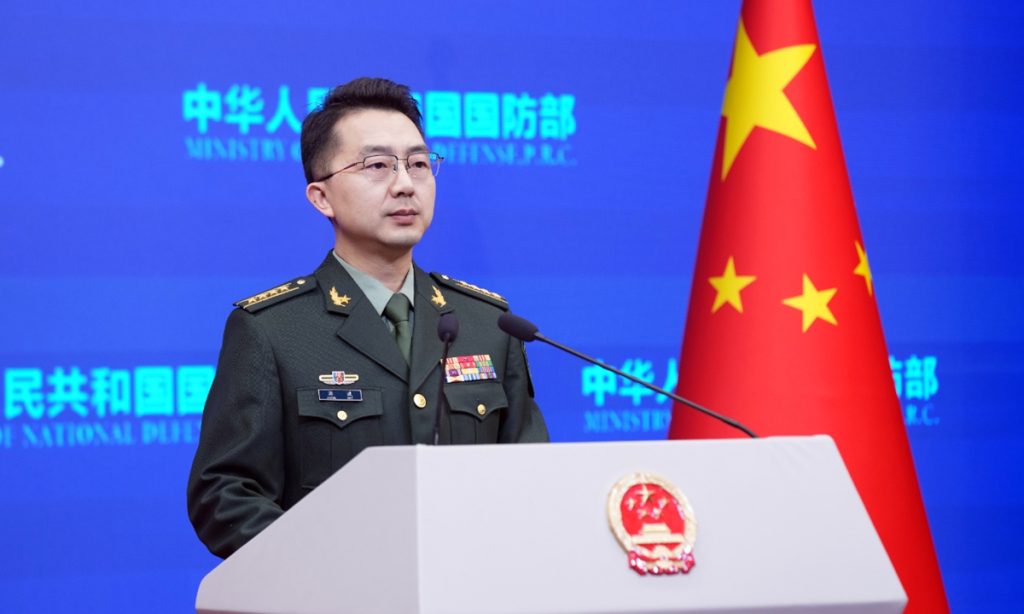
A shipborne helicopter from the Dutch Navy frigate De Ruyter illegally intruded into the airspace over China's Xisha Qundao, seriously violating China's sovereignty and undermining China's security interests, and the Chinese military organized maritime and aerial forces to take effective measures to dispel the helicopter out of the area and has lodged solemn representations with the Dutch side, a spokesperson for the Chinese Ministry of National Defense (MND), said on Thursday.
"The Xisha Qundao is China's inherent territory. The Chinese military remains on high alert and resolutely defends national territorial sovereignty and maritime rights and interests. We urge the Dutch side to stop its infringements, risky and provocative acts, and strictly restrain frontline sea and air forces to avoid any unexpected incidents at sea or in the air," said Jiang Bin, spokesperson for the Chinese Ministry of National Defense.
The response followed on Wednesday a spokesperson for the Chinese People's Liberation Army (PLA) Southern Theater Command also expressed firm opposition to the intrusion.
According to the WeChat account of the Command, Senior Captain Zhai Shichen said that a Dutch Navy frigate, De Ruyter, illegally trespassed into China's Xisha Qundao in the South China Sea and conducted multiple shipborne helicopter operations violating China's territorial airspace.
The PLA Southern Theater Command organized maritime and air forces to take necessary measures in accordance with laws and regulations to expel and drive away the trespassing vessel, according to Zhai.
Troops of the PLA Southern Theater Command remain on high alert and are resolute in their duty to safeguard national sovereignty, security and regional peace and stability, Zhai added.
Five people were dead and another was injured after a fire broke out in a shop in central China's Hunan Province on Sunday, according to local authorities.
The fire broke out in a shop in Qidong County at 12:45 a.m., and the injured person is receiving medical treatment with non-life-threatening injuries, the county's emergency management bureau said.
Relevant aftermath work and investigation of the cause of the accident are underway.
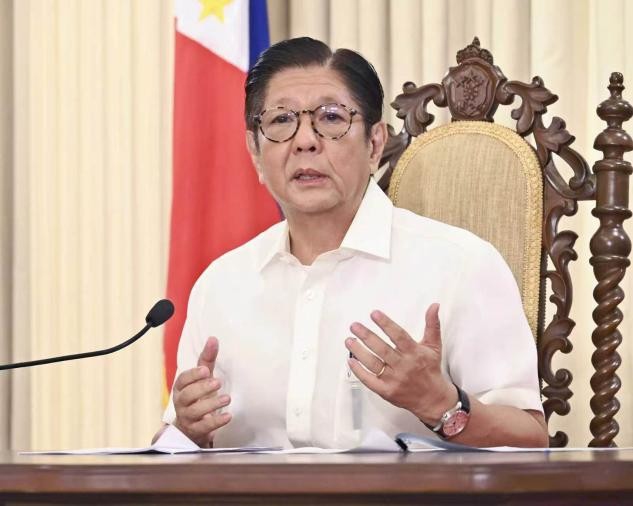
Philippine President Ferdinand Marcos Jr. will undertake a state visit to Japan from May 26 to 29, during which he is set to meet Japanese Prime Minister Sanae Takaichi and they are reportedly expected to discuss "cooperation toward realizing a free and open Indo-Pacific" and "coordinating responses to China's maritime expansion," according to media reports.
Several media reports previewed the agenda for the talks, with Manila Bulletin releasing a report titled "Security ties with Japan top Marcos' agenda during Tokyo trip." Philippine media GMA News reported that the Philippine president and the Japanese prime minister are expected to discuss the future trajectory of the Philippines and Japan's strengthened strategic partnership. The Japan Times reported that Marcos and Takaichi will discuss Japan's evolving defense and security posture, and will also likely to involve another subject that has garnered headlines in recent days: Taiwan.
A Chinese expert said that beyond economic and trade cooperation, the talks between Japan and the Philippines will inevitably involve military and security cooperation, defense exports, particularly on maritime security, the South China Sea, and Taiwan-related issues.
Coordination and cooperation on maritime issues between the Philippines and Japan has been gradually closer, extending into the South China Sea, the East China Sea and even the Taiwan Straits. Against this backdrop, Marcos' repeated claims that he adheres to the one-China principle are fundamentally contradictory and inconsistent to his actual actions, revealing a highly two-faced strategic posture, and the real objective of the Philippines and Japan is to exploit seabed resources and gain access to undersea mineral wealth in waters around the Taiwan Straits, the expert said.
An X user claiming to be Philippine media figure Benjamin Alejandro recently released a report titled "hidden agendas behind Marcos's visit to Japan," claiming that on maritime issues, Philippine and Japan are expected to reaffirm the arbitral ruling on the South China Sea and coordinate positions on the East China Sea and the Taiwan Straits. There is even talk of consultations with Taiwan authorities on maritime delimitation, potentially expanding into the western Pacific east of Taiwan island.
Some netizens expressed their voices of criticism in the comment section under the X of the article, with one saying "Ugly things are never put in the sun!" and another saying "Marcos is crazy to hype up those maritime issues, I expect China to hit back hard."
It is worth noting that in an interview with Japanese media on Monday, Marcos just reaffirmed the Philippines' adherence to the one-China policy and stressed that the country would not interfere in issues concerning Taiwan island, the Philippine News Agency reported.
When asked by foreign media reporter to comment on Marcos's remarks on Monday that his country would likely be involved in any conflict over Taiwan due to his country's proximity to the island, claiming that "we do not have a choice because Taiwan is so close to the Philippines, and we have almost 200,000 Filipino nationals living and working in Taiwan," Chinese Foreign Ministry spokesperson Guo Jiakun said at Tuesday's press briefing that China noted that the Philippine leader reiterates his commitment to the one-China policy and non-interference in China's internal affairs. It should be emphasized that, "large number of Filipinos living and working" on the Taiwan island and "geopolitical proximity" should not serve as the excuse for one country to interfere in another country's internal and sovereign affairs.
We hope the Philippines will honor its commitments, match its words with actions, and abide by the one-China principle through concrete actions, Guo said.
Marcos' remarks exposed contradictions between Manila's repeated claims of adhering to the one-China principle and its actual strategic behavior. If they discuss maritime delimitation issue, it reflects the long-standing ambitions of both the Philippines and Japan to pursue maritime and military expansion, Chen Xiangmiao, a research fellow at the National Institute for South China Sea Studies, told the Global Times on Thursday.
The expert emphasized that the Philippines' real objective is to secure rights to exploit seabed resources and gain access to undersea mineral wealth in waters around Taiwan island. By attempting to use the Japan's defense related-advantages and the Taiwan authorities to expand its own access to mineral resources, the Philippines is in essence interfering in China's internal affairs, Chen said.
Chen noted that with right-wing forces increasingly dominating Japanese politics and pushing what many see as a dangerous revival of militarism, Tokyo has in recent years continuously sought to expand its continental shelf claims. If the Philippines further enables and advances such a proposal, it would first have a severely destabilizing impact on maritime security.
The key issue now is whether Manila will match its public commitment to the one-China principle with concrete actions. If the Philippines continues to insist on such a contradictory approach, it will further erode mutual trust and inevitably bring negative consequences to bilateral ties and regional stability, Chen said.
Chinese President Xi Jinping held a welcome ceremony on Wednesday morning outside the Great Hall of the People in central Beijing for Russian President Vladimir Putin, who is on a state visit to China.
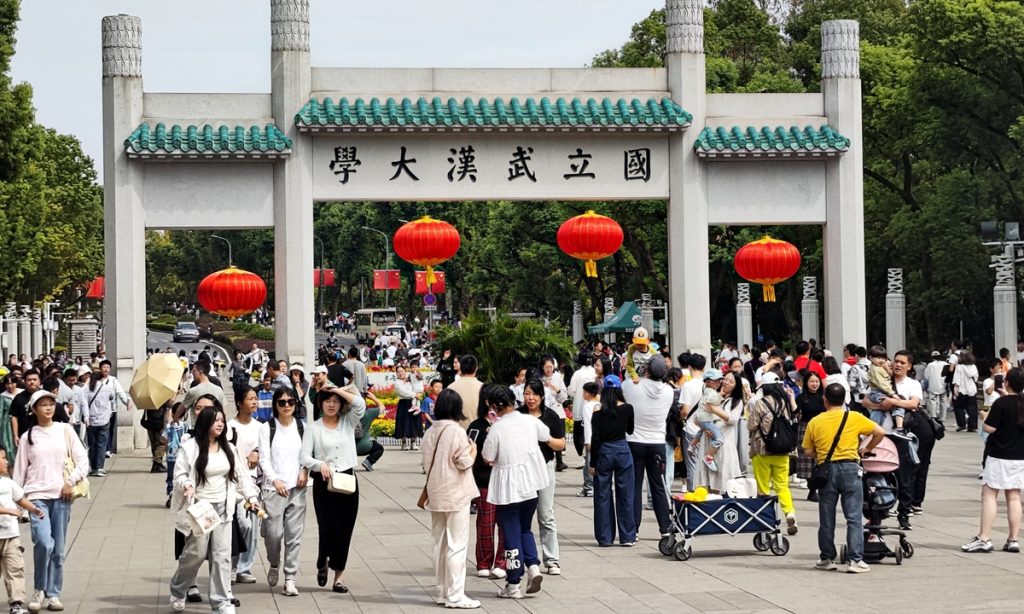
Wuhan University, one of the most prestigious universities in China, officially dropped its reservation requirement for public campus entry on Wednesday. Visitors can now enter on foot through Luojia Gate and Hongyi Gate with valid IDs — no reservations needed - on weekdays, weekends and holidays, reported Hubei Daily, citing sources from the university.
The university introduced a reservation system in July 2023, requiring visitors to book their visits in advance. Access was limited to weekends and holidays, while weekday entry was not allowed. The policy was first eased in September 2024. Visitors were allowed to enter on foot during weekends and holidays by presenting their ID cards without making reservations, although the campus remained closed on weekdays.
"University management should not stop at the campus walls," Chu Zhaohui, a research fellow at the National Institute of Education Sciences, told the Global Times on Thursday, adding that universities need to take on broader social responsibilities and engage more with society, while finding ways to remain open and maintain orderly campus operations.
Wuhan University boasts a rich academic environment and is widely celebrated for its breathtakingly beautiful campus, often hailed as one of China's most beautiful university campuses, according to the Xinhua News Agency.
The cherry blossoms at the university are undoubtedly one of its most spectacular highlights. They usually begin blooming in mid-March, peak in late March and last only about 13 to 20 days. Every year when the cherry blossoms are in full bloom, tourists from all over the country flock to the campus in large numbers, Xinhua said.
The university's decision to reopen its campus more broadly to the public also sparked discussion on social media.
Xu Shunda, a campus-focused blogger who has 2.55 million followers, voiced support for the move. "Breaking down the barriers created by campus walls," Xu wrote, adding that universities are public educational resources and "should not be locked away behind layer upon layer of walls."
Some social media users expressed concerns about the decision, arguing that allowing visitors to enter the campus without reservations could attract large numbers of social media influencers and tourists checking in for photos, potentially disrupting teaching and campus order.
Some students from other universities expressed concern that the policy was impractical, arguing that unrestricted public access could lead to more crowded campuses, reduced order and great in convenient for students.
Chu said people should see the experience as part of a learning process, one that involves mutual respect as well as exposure to and appreciation for campus culture.
According to the official website of Fudan University, visitors who wish to visit the campus are required to register through the university's e-campus WeChat mini program. Information on the platform shows the registration process is relatively simple. After completing registration, visitors can enter the campus during their selected time slot using valid IDs or by scanning a QR code.
Meanwhile, Peking University and Tsinghua University, both popular tourist destinations in Beijing, still require reservations for campus visits, though visitors can enter after completing a similarly simple registration process through their WeChat mini programs.
Former Tsinghua University professor Zheng Yuhuang has posted multiple videos praising Wuhan University for opening its campus to the public. In 2026, Zheng launched a project called the "Campus Gate Experiment," where he has personally taken his mother to visit 26 universities in Beijing, Zhejiang, and Shanghai.
He pointed out online that most Chinese universities are not open to the public, whereas many university campuses abroad are open to society. He hopes that all universities in China can adopt a policy allowing entry simply by scanning an ID card.
Chu suggested that other universities could also consider gradually expanding public access based on practical conditions and social demand. He added that campus openness should go beyond simply allowing public entry, with universities encouraged to organize more public welfare activities and lectures, and create opportunities for students to engage with the broader society, which he said would also benefit talent cultivation and students' personal growth.