Chinese Embassy in Japan reveals series of recently received terror threats and absence of effective measures by Japanese police
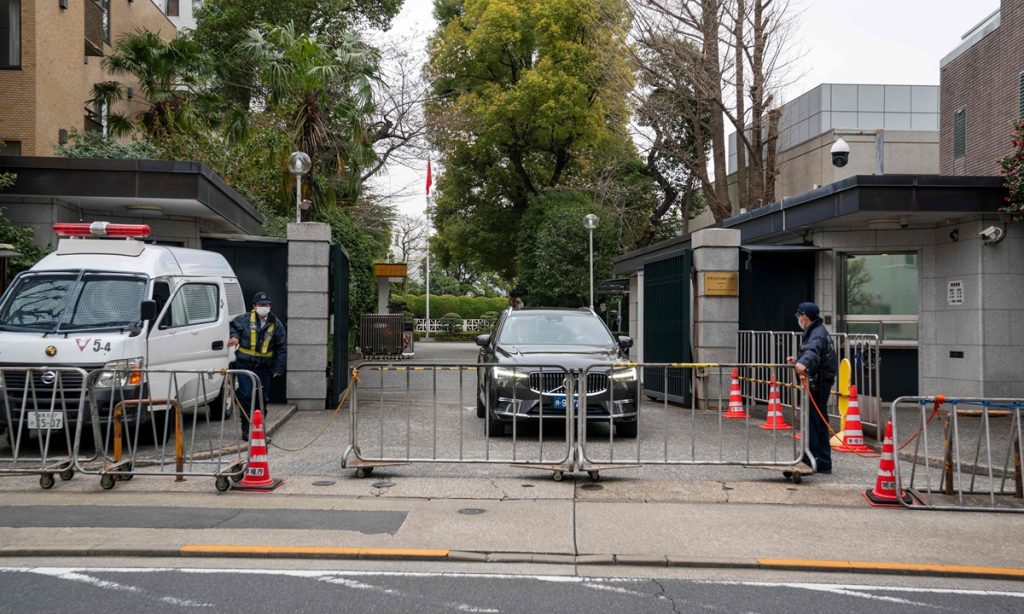
Shi Yong, Charge d'Affaires ad interim of Chinese Embassy in Japan, briefed on the recent series of terror threats received by the embassy at a press conference held on Thursday, according to CCTV News. Shi noted that the Japanese police didn't attach importance to the report of the embassy.
Shi Yong revealed that on March 5, an organization claiming to consist of former Japanese police officers and former Self-Defense Forces members sent a terror threat letter to the embassy, threatening that they would launch attacks on Chinese diplomatic and consular missions in Japan, per the CCTV News report.
After receiving the letter, the embassy immediately reported it to the Japanese police. However, the Japanese police did not take the threat seriously, failed to take effective measures, and have not yet identified the truth behind the incident, the report highlighted.
Nineteen days later, a serious incident occurred in which active-duty Japan Self-Defense Forces member Kodai Murata broke into the Chinese Embassy by scaling the wall carrying a knife on March 24. The Chinese side immediately lodged strong representations with Japan's Ministry of Foreign Affairs and the police.
Just one week after the break-in incident, on March 31, according to the CCTV News report, another individual claiming to be a reserve Self-Defense Forces member sent a terror threat to the embassy via the internet, claiming that he had planted a remote-controlled bomb inside the Chinese Embassy.
The embassy immediately reported the threat to the police, and Japanese police conducted a nearly two-hour bomb disposal operation at the embassy that same day.
The Chinese Embassy in Japan stated that the above incidents seriously violate international law, gravely infringe upon China's sovereignty and dignity, and threaten the safety of Chinese diplomatic personnel as well as the security of diplomatic premises. The nature and impact of these incidents are extremely egregious, it stated.
The Chinese Embassy in Japan said that it has lodged nearly 30 rounds of representations with Japanese police over the recent spate of terror threats, yet little progress has been made in relevant investigations. Having repeatedly elaborated its stern position and clear demands, Chinese side once again strongly urged Japan to speed up the case probe, severely punish perpetrators in accordance with law, offer a responsible explanation to China, and take effective measures to safeguard the premises and staff of Chinese diplomatic and consular missions in Japan so as to prevent similar incidents from recurring, Xinhua reported.
Xiang Haoyu, a distinguished research fellow at the China Institute of International Studies, told the Global Times on Thursday that in the early stages of the incident, the Japanese police responded to the embassy's report with a passive and perfunctory attitude. The case was left unresolved for a prolonged period, allowing the threats to escalate.
This clearly demonstrates insufficient attention to Chinese embassy's security concerns and a dereliction of duty. Only afterward, under pressure from public opinion and diplomatic channels, did they announce measures to strengthen security, Xiang noted. "This was obviously a passive, remedial action that barely conceals their earlier inaction and negligence."
Xinhua News Agency in a report Wednesday noted that the incident has sparked widespread shock and concern due to its severity and potential implications. However, the Japanese government has so far only responded by calling it "deeply regrettable," a stance that has drawn criticism.
Japanese police on Tuesday re-arrested Kodai Murata, Xinhua reported, citing Japanese media. Japan's NHK, citing sources, reported on the same day that an incident similar to Chinese Embassy intrusion case took place "several years ago." According to the NHK report, "In both incidents, the sources say the intruders entered the adjacent buildings through unlocked doors. Following the earlier case, police are said to have asked property managers in the neighborhood to take preventive measures. But the building used in the latest case was not fully locked," per the report.
The head of Japan's National Police Agency (NPA) on Wednesday stressed the urgent need to prevent any recurrence of incidents involving forced entry into foreign diplomatic missions, Xinhua reported on Wednesday, citing local media.
Chinese observers expressed suspicion that the Japanese police's approach in handling this matter has in fact still been quite passive. They showed no serious regard for the gravity of the problem and instead adopted an attitude of indulgence and shielding," Lü Chao, an expert at the Liaoning Academy of Social Sciences, told the Global Times on Thursday.
Lü noted that in reality, Japan has exposed to the international community its unreasonable and egregious attitude of tolerating and condoning terrorist threats and intimidation. There is no doubt that this will have a very negative impact on Japan itself."
The successive extreme threats reflect a dangerous trend of intensifying right-wing tendencies in Japanese society, where anti-China sentiment - long fueled and inflamed by politicians and the media - has become rampant. In particular, the involvement of active-duty and reserve Self-Defense Force personnel as well as former police officers exposes how extremist ideologies have already penetrated specific groups, with hostility toward China shifting from rhetoric to violent action, Xiang warned.